USP
It uniquely bridges AI assistants with LangSmith's comprehensive observability platform via the open MCP standard, offering both a hosted option for quick integration and a self-hostable server for custom deployments. Its character-based p…
Use cases
- 01Fetching conversation history for context-aware chatbots
- 02Managing and retrieving prompt templates for consistent LLM behavior
- 03Analyzing LLM traces and runs for debugging and performance monitoring
- 04Accessing datasets and examples for evaluation and fine-tuning
- 05Monitoring LangSmith billing usage for cost management
Detected files (1)
CLAUDE.mdclaude_mdShow content (27447 bytes)
# LangSmith MCP Server - Technical Reference & Development Guide

## ⚠️ IMPORTANT: Keeping This Document Updated
**When you make changes to this codebase, please update this CLAUDE.md file if:**
- You add or remove MCP tools
- You modify the architecture or add new modules
- You change configuration requirements or setup procedures
- You add new dependencies or change build processes
- You discover important patterns or best practices

This document serves as the primary context for AI assistants working on this project. Keeping it accurate ensures efficient development.

---

## Project Overview

The LangSmith MCP Server is a production-ready Model Context Protocol (MCP) server that provides seamless integration with the LangSmith observability platform. This server enables AI language models to programmatically interact with LangSmith's suite of tools for conversation tracking, prompt management, dataset operations, and trace analytics.

### What is LangSmith?
LangSmith is LangChain's comprehensive observability and evaluation platform for LLM applications, providing:
- Conversation thread tracking and history
- Prompt template management and versioning
- Dataset creation and management for testing
- Trace collection and analysis for debugging
- Performance analytics and monitoring
- Billing and usage tracking

### What is MCP?
The Model Context Protocol (MCP) is an open standard that enables secure connections between AI assistants and external data sources and tools. This server implements the MCP specification to bridge AI models with LangSmith's capabilities.

---

## Architecture Deep Dive

### Core Components

#### 1. Server Architecture ([server.py](langsmith_mcp_server/server.py))
The server is built on FastMCP, a high-performance MCP framework that provides:
- **Transport Layer**: Uses stdio transport for CLI/desktop integration, HTTP for web-based access
- **Tool Registration**: Modular system for registering LangSmith tools via `register_tools()`
- **Middleware Stack**: API key authentication and CORS handling
- **Error Handling**: Comprehensive exception handling across all operations

```python
# Core server initialization (actual implementation)
mcp = FastMCP("LangSmith API MCP Server")

# Modular registration system (no client parameter - uses middleware)
register_tools(mcp)
register_prompts(mcp)      # Currently empty stub
register_resources(mcp)    # Currently empty stub
```

**Key Architecture Notes:**
- API keys are handled per-request via [middleware.py](langsmith_mcp_server/middleware.py), not at server initialization
- The server supports both stdio (CLI) and HTTP transports
- HTTP mode runs via uvicorn and is configured in the Dockerfile
- **Client disconnect patch**: [streamable_http_patch.py](langsmith_mcp_server/streamable_http_patch.py) patches the MCP streamable HTTP transport so that when the client (or proxy) closes the connection early, the server logs and continues instead of crashing with `ClosedResourceError` / `BrokenResourceError` (see [Troubleshooting](#7-http-streamable-client-disconnect-crashes)).

#### 2. Authentication & Middleware ([middleware.py](langsmith_mcp_server/middleware.py))
Request-scoped authentication system that:
- Extracts `LANGSMITH-API-KEY` header from requests
- Supports optional `LANGSMITH-WORKSPACE-ID` and `LANGSMITH-ENDPOINT` headers
- Stores credentials in context variables for access by tools
- Returns 401 for missing API keys (except /health endpoint)
- Sets **session/thread id** for monitoring: from `mcp-session-id`, `x-session-id`, or `x-request-id` header, or a generated UUID per request
- Automatically cleans up context after each request

```python
# Context variables used throughout the application
api_key_context: ContextVar[str]
workspace_id_context: ContextVar[str]
endpoint_context: ContextVar[str]
```

#### 2b. Optional Monitoring ([monitoring.py](langsmith_mcp_server/monitoring.py))
When configured, tool calls are traced to a **separate** LangSmith instance for observability (e.g. to monitor MCP usage by session). Configuration is read from environment (e.g. `.env`):

- **LANGSMITH_MONITORING_API_KEY**: API key for the monitoring LangSmith instance (if unset, monitoring is disabled)
- **LANGSMITH_MONITORING_ENDPOINT**: Optional endpoint URL
- **LANGSMITH_MONITORING_WORKSPACE_ID**: Optional workspace ID
- **LANGSMITH_MONITORING_PROJECT**: Project name for monitoring traces (default: `mcp-server-monitoring`)

Each tool execution is logged with `run_type="tool"` via LangSmith's `@traceable` decorator; inputs and outputs are captured, and `session_id` is set in run metadata so you can filter/analyze by session. For tracing to be sent, `LANGSMITH_TRACING` must be set to `"true"` (see LangSmith custom instrumentation docs).

#### 3. Client Management ([common/helpers.py](langsmith_mcp_server/common/helpers.py))
Helper functions for LangSmith client creation and management:
- `get_langsmith_client_from_api_key()`: Creates Client instances from API keys (no `os.environ` mutation; credentials passed explicitly to avoid cross-request races)
- `get_client_from_context()`: Retrieves client from FastMCP context; reuses one Client per request via request-scoped state to reduce memory churn
- `get_api_key_and_endpoint_from_context()`: Extracts credentials from context
- No custom wrapper class - uses standard `langsmith.Client` directly

#### 4. Service Layer Architecture

**Tools ([services/tools/](langsmith_mcp_server/services/tools/))**
- [datasets.py](langsmith_mcp_server/services/tools/datasets.py): Dataset CRUD operations and example management
- [prompts.py](langsmith_mcp_server/services/tools/prompts.py): Prompt discovery, retrieval, and template access
- [traces.py](langsmith_mcp_server/services/tools/traces.py): Conversation history, run fetching, thread management
- [experiments.py](langsmith_mcp_server/services/tools/experiments.py): Experiment listing and management
- [usage.py](langsmith_mcp_server/services/tools/usage.py): Billing and usage tracking (trace counts)
- [workspaces.py](langsmith_mcp_server/services/tools/workspaces.py): **Empty stub** (future workspace management)

**Prompts ([services/prompts/](langsmith_mcp_server/services/prompts/))**
- Currently empty - only contains `__init__.py`
- [register_prompts.py](langsmith_mcp_server/services/register_prompts.py) is a stub (just `pass`)

**Resources ([services/resources/](langsmith_mcp_server/services/resources/))**
- Currently empty - only contains `__init__.py`
- [register_resources.py](langsmith_mcp_server/services/register_resources.py) is a stub (just `pass`)

**Common Utilities ([common/](langsmith_mcp_server/common/))**
- [helpers.py](langsmith_mcp_server/common/helpers.py): Client creation, UUID conversion, dictionary utilities
- [pagination.py](langsmith_mcp_server/common/pagination.py): Run and message pagination logic
- [formatters.py](langsmith_mcp_server/common/formatters.py): Output formatting utilities

**Monitoring ([monitoring.py](langsmith_mcp_server/monitoring.py))**
- Optional: loads `.env`, creates a second LangSmith client from `LANGSMITH_MONITORING_*` env vars
- Wraps each tool call in `@traceable(run_type="tool")` to the monitoring project with `session_id` in metadata
- Session id is set per HTTP request in middleware (from headers or generated)

---

## Available MCP Tools

All tools are registered in [register_tools.py](langsmith_mcp_server/services/register_tools.py). Here's the complete list:

### Prompt Management
- `list_prompts(is_public: str, limit: int)` - Fetch prompts with filtering
- `get_prompt_by_name(prompt_name: str)` - Get specific prompt by name
- `push_prompt()` - **Documentation tool** explaining how to push prompts

### Conversation & Thread Management
- `get_thread_history(thread_id: str, project_name: str, limit: int, offset: int)` - Retrieve conversation history with pagination
- `fetch_runs(project_name: str, limit: int, page_number: int, ...)` - Fetch runs with extensive filtering and automatic character-based pagination

### Project Management
- `list_projects(limit: int, project_name: str, ...)` - List and search projects

### Billing & Usage
- `get_billing_usage(starting_on: str, ending_before: str, workspace_id: str)` - Get billing usage and trace counts

### Experiments
- `list_experiments(reference_dataset_id: str, reference_dataset_name: str, ...)` - List experiments with filtering
- `run_experiment()` - **Documentation tool** explaining how to run experiments

### Dataset Operations
- `list_datasets(dataset_ids: str, data_type: str, dataset_name: str, ...)` - List datasets with filtering
- `list_examples(dataset_id: str, dataset_name: str, ...)` - List examples from datasets
- `read_dataset(dataset_id: str, dataset_name: str)` - Read complete dataset
- `read_example(example_id: str, as_of: str)` - Read specific example
- `create_dataset()` - **Documentation tool** explaining how to create datasets
- `update_examples()` - **Documentation tool** explaining how to update examples

### Important Notes on Tools:
- **Documentation tools** (`push_prompt`, `create_dataset`, `update_examples`, `run_experiment`) don't perform actions - they return instructions
- **All results are paginated**: `fetch_runs` always returns paginated responses with `page_number`, `total_pages`, and character budget controls
- Several tool implementations exist in [traces.py](langsmith_mcp_server/services/tools/traces.py) but are **NOT registered**:
  - `fetch_trace_tool()` - exists but not exposed as MCP tool
  - `get_project_runs_stats_tool()` - exists but not exposed as MCP tool
- All tools use `ctx: Context` parameter to access API keys from middleware

---

## Development Environment Setup

### Prerequisites
- **Python**: 3.10+ (type-checked and tested)
- **uv**: Fast Python package manager and resolver ([install guide](https://docs.astral.sh/uv/))
- **LangSmith API Key**: Get from [smith.langchain.com](https://smith.langchain.com)

### Installation

#### Development Setup
```bash
# Clone and setup development environment
git clone https://github.com/langchain-ai/langsmith-mcp-server.git
cd langsmith-mcp-server

# Create isolated environment with all dependencies
uv sync

# Include test dependencies for development
uv sync --group test

# Verify installation
uvx langsmith-mcp-server
```

#### Production Deployment
```bash
# Install from PyPI
uv pip install langsmith-mcp-server

# Or use uvx to run directly
uvx langsmith-mcp-server
```

---

## Development Best Practices

### 🚨 CRITICAL: Always Run Lint and Format Before Committing

**Every time you make code changes, you MUST run:**

```bash
make format    # Auto-format code with ruff
make lint      # Check code style and find issues
```

**Why this matters:**
- CI will fail if code doesn't pass linting
- Maintains consistent code style across the project
- Catches common bugs and issues early
- ruff is configured in [pyproject.toml](pyproject.toml) with project-specific rules

### Development Workflow

1. **Make your changes** to the code
2. **Run format and lint** (always!)
   ```bash
   make format
   make lint
   ```
3. **Run tests** to ensure nothing broke
   ```bash
   make test
   ```
4. **Test with MCP Inspector** (for tool changes)
   ```bash
   uv run mcp dev langsmith_mcp_server/server.py
   ```
5. **Update CLAUDE.md** if you added features or changed architecture
6. **Commit your changes**

### Testing Guidelines

```bash
# Run all tests
make test

# Run specific test file
make test TEST_FILE=tests/tools/test_dataset_tools.py

# Run tests in watch mode (continuous testing)
make test_watch

# Type checking
uv run mypy langsmith_mcp_server/
```

### Code Quality Standards

- **Type Hints**: All functions should have type annotations
- **Docstrings**: Public functions need docstrings explaining purpose, args, and returns
- **Error Handling**: Always return `{"error": str(e)}` rather than raising exceptions in tools
- **Line Length**: 100 characters (configured in ruff)
- **Import Sorting**: Automatic via ruff's isort integration

---

## Development Tools & Workflows

### MCP Inspector (Interactive Testing)
```bash
# Start development server with browser-based inspector
uv run mcp dev langsmith_mcp_server/server.py
```

Features:
- **Real-time Testing**: Call tools interactively through web UI
- **Environment Configuration**: Set `LANGSMITH_API_KEY` and test different configs
- **Tool Discovery**: Browse all registered tools and their schemas
- **Request/Response Debugging**: See exact inputs/outputs for each call
- **Great for**: Testing new tools, debugging issues, exploring functionality

### Configuration Files

#### [pyproject.toml](pyproject.toml)
- **Build System**: pdm-backend for modern Python packaging
- **Dependencies**: fastmcp, langsmith, langchain-core, uvicorn
- **Test Dependencies**: pytest, ruff, mypy, pytest-asyncio, pytest-socket
- **Entry Point**: `langsmith-mcp-server` command maps to `server:main()`
- **Ruff Config**: Line length 100, Python 3.10+, specific lint rules
- **Pytest Config**: Async support, socket restrictions, verbose output

#### [Makefile](Makefile)
Provides convenient commands:
- `make lint` - Check code style (ruff format --diff + ruff check --diff)
- `make format` - Auto-format code (ruff check --fix + ruff format)
- `make test` - Run pytest with socket restrictions and 10s timeout
- `make test_watch` - Continuous testing during development

#### [Dockerfile](Dockerfile)
- **Base**: Python 3.12 Alpine (minimal footprint)
- **Build Deps**: gcc, musl-dev, libffi-dev for compiled extensions
- **Package Manager**: Uses uv for fast installation
- **Security**: Runs as non-root user (uid 1000)
- **Entry Point**: `uvicorn langsmith_mcp_server.server:app` on port 8000 (HTTP mode)
- **Note**: Dockerfile uses HTTP transport, not stdio

---

## Integration Patterns

### MCP Client Configuration

#### Cursor IDE Integration
Add to `.cursorrules` or MCP settings:
```json
{
    "mcpServers": {
        "LangSmith API MCP Server": {
            "command": "uvx",
            "args": ["langsmith-mcp-server"],
            "env": {
                "LANGSMITH_API_KEY": "lsv2_pt_your_key_here"
            }
        }
    }
}
```

#### Claude Desktop Integration
Add to `~/Library/Application Support/Claude/claude_desktop_config.json`:
```json
{
    "mcpServers": {
        "LangSmith API MCP Server": {
            "command": "uvx",
            "args": ["langsmith-mcp-server"],
            "env": {
                "LANGSMITH_API_KEY": "lsv2_pt_your_key_here"
            }
        }
    }
}
```

#### Source-based Development Integration
For local development with your working copy:
```json
{
    "command": "uv",
    "args": [
        "--directory", "/absolute/path/to/langsmith-mcp-server",
        "run", "langsmith-mcp-server"
    ],
    "env": {
        "LANGSMITH_API_KEY": "lsv2_pt_your_key_here"
    }
}
```

---

## Common Use Cases & Examples

### 1. Conversation History Retrieval
```python
# Get conversation thread history
result = get_thread_history(
    thread_id="thread-abc123",
    project_name="my-chatbot-project",
    limit=50,
    offset=0
)
```

### 2. Prompt Library Management
```python
# List available prompts
prompts = list_prompts(is_public="true", limit=20)

# Get specific prompt
template = get_prompt_by_name("customer-support-agent")
```

### 3. Dataset Operations
```python
# List datasets
datasets = list_datasets(data_type="chat", limit=10)

# Get examples from a dataset
examples = list_examples(dataset_name="test-cases", limit=100)

# Read specific example
example = read_example(example_id="example-uuid")
```

### 4. Project and Run Management
```python
# List projects
projects = list_projects(limit=10, project_name="production")

# Fetch runs with filtering (always paginated)
result = fetch_runs(
    project_name="my-app",
    limit=20,
    page_number=1,
    run_type="chain",
    is_root="true"
)
# result includes: runs, page_number, total_pages, max_chars_per_page, preview_chars

# Paginate through all pages
for page in range(2, result["total_pages"] + 1):
    fetch_runs(project_name="my-app", limit=20, page_number=page)
```

### 5. Usage Tracking
```python
# Get billing usage
usage = get_billing_usage(
    starting_on="2025-01-01",
    ending_before="2025-02-01",
    workspace_id="optional-workspace-id"
)
```

---

## Error Handling & Reliability

### Exception Management
- **All tools return dictionaries**: Never raise exceptions to MCP clients
- **Error format**: `{"error": "description of error"}`
- **Client validation**: API key checked by middleware before tool execution
- **Input sanitization**: Parameters validated and type-coerced where appropriate
- **Graceful degradation**: Tools return partial results when possible

### Security Considerations
- **API Key Protection**: Keys passed via headers (HTTP) or environment (stdio), never logged
- **Request Isolation**: Each request gets its own context, no cross-contamination
- **Input Validation**: All user inputs sanitized before passing to LangSmith SDK
- **Network Security**: Tests run with `--disable-socket` to prevent accidental external calls
- **Minimal Attack Surface**: Non-root Docker user, minimal dependencies

### Performance Optimizations
- **Lazy Client Creation**: LangSmith client only created when needed per request
- **Request-Scoped Client Reuse**: One Client per request (cached in FastMCP request state) to avoid creating many clients under load and reduce memory churn
- **No os.environ Mutation**: Credentials are passed explicitly to the Client constructor; we do not set `LANGSMITH_API_KEY` etc. in the process environment, avoiding concurrent-request races that can cause 403 Forbidden
- **Pagination Support**: Large result sets can be paginated (runs, messages, examples)
- **Efficient Filtering**: Most tools support server-side filtering to reduce data transfer
- **Connection Reuse**: HTTP client connection pooling via httpx (used by langsmith SDK)

---

## Project Structure Reference

```
langsmith-mcp-server/
├── langsmith_mcp_server/
│   ├── server.py                 # Main MCP server, FastMCP app, HTTP/stdio setup
│   ├── streamable_http_patch.py  # Client-disconnect handling for HTTP streamable transport
│   ├── middleware.py            # API key authentication middleware
│   ├── monitoring.py             # Optional: trace tool calls to second LangSmith (session_id, run_type=tool)
│   ├── common/
│   │   ├── helpers.py            # Client creation, UUID conversion, utilities
│   │   ├── pagination.py         # Pagination logic for runs and messages
│   │   └── formatters.py         # Output formatting
│   └── services/
│       ├── register_tools.py     # Tool registration (all @mcp.tool() definitions)
│       ├── register_prompts.py   # Stub (empty)
│       ├── register_resources.py # Stub (empty)
│       ├── tools/
│       │   ├── datasets.py       # Dataset and example operations
│       │   ├── prompts.py        # Prompt management
│       │   ├── traces.py         # Thread history, runs, traces
│       │   ├── experiments.py    # Experiment listing
│       │   ├── usage.py          # Billing/usage tracking
│       │   └── workspaces.py     # Stub (empty)
│       ├── prompts/              # Empty (future: MCP prompts)
│       └── resources/            # Empty (future: MCP resources)
├── tests/
│   ├── tools/
│   │   └── test_dataset_tools.py
│   └── test_mock.py
├── examples/                     # Example scripts showing tool usage
│   ├── fetch_runs.py
│   ├── get_thread_history.py
│   ├── fetch_trace.py
│   ├── get_run_stats.py
│   ├── datasets_annotation.py
│   └── ...
├── pyproject.toml               # Project config, dependencies, tool settings
├── Makefile                     # Development commands (lint, format, test)
├── Dockerfile                   # HTTP server deployment
└── CLAUDE.md                    # This file - keep it updated!
```

---

## Troubleshooting Guide

### Common Issues

1. **API Key Problems**
   - Error: "Missing LANGSMITH-API-KEY header" (HTTP) or client initialization failures (stdio)
   - Solution: Ensure `LANGSMITH_API_KEY` is set in environment or headers
   - Verify key format: should start with `lsv2_pt_`

2. **Import Errors**
   - Error: Module not found
   - Solution: Run `uv sync` to install dependencies
   - For tests: `uv sync --group test`

3. **Linting Failures**
   - Error: CI fails on PR, ruff errors
   - Solution: Always run `make format && make lint` before committing
   - Auto-fix most issues: `make format`

4. **Test Failures**
   - Error: `pytest.PytestUnraisableExceptionWarning` or socket errors
   - Solution: Tests use `--disable-socket` to prevent external calls
   - Mock external dependencies in tests

5. **MCP Inspector Not Working**
   - Error: Can't connect or tools not showing
   - Solution: Ensure running `uv run mcp dev langsmith_mcp_server/server.py`
   - Check that port isn't already in use
   - Set `LANGSMITH_API_KEY` in inspector UI after starting

6. **403 Forbidden or memory limit under load (e.g. hosted Render)**
   - Error: `403 Client Error: Forbidden` on valid API key, or instance hits memory limit after traffic spikes
   - Cause: Previously the server mutated `os.environ` with the request's API key, so concurrent requests could overwrite each other's credentials (leading to 403). Creating a new LangSmith Client on every tool call also increased memory use under load.
   - Solution: The codebase now (1) does not set `os.environ` for LangSmith; credentials are passed explicitly to the Client, and (2) reuses one Client per request via FastMCP request-scoped state. If you run an older version, upgrade. For hosted deployments, consider memory limits and request timeouts (see item 7).

7. **HTTP streamable client disconnect crashes**
   - Error: `anyio.BrokenResourceError` / `anyio.ClosedResourceError`, "SSE response error", or `ExceptionGroup` in `streamable_http._handle_post_request`
   - Cause: Client or proxy (e.g. load balancer) closed the connection before the server finished sending.
   - Solution: The server applies a patch at startup ([streamable_http_patch.py](langsmith_mcp_server/streamable_http_patch.py)) to catch these and log at debug level instead of crashing. If you still see crashes, ensure the patch is applied (HTTP app is created and patch runs). On Render or behind a proxy, increase request/response timeouts (e.g. 60s+ for `/mcp`) so the connection is not closed while the server is still working.
   - Upstream: [python-sdk#2064](https://github.com/modelcontextprotocol/python-sdk/issues/2064), [PR #2072](https://github.com/modelcontextprotocol/python-sdk/pull/2072). When a fix is released, upgrading `mcp`/`fastmcp` may allow removing the patch.

### Development Debugging

1. **Use MCP Inspector**: Best way to test tools interactively
2. **Check Logs**: FastMCP logs to stdout, watch for errors
3. **Test Individual Tools**: Import and call tool functions directly in Python
4. **Use Examples**: The `examples/` directory shows working usage patterns
5. **Type Checking**: Run `uv run mypy langsmith_mcp_server/` to catch type errors

---

## Contributing Guidelines

### Adding a New Tool

1. **Implement the tool function** in appropriate `services/tools/*.py` file
   ```python
   def my_new_tool(client: Client, param: str) -> Dict[str, Any]:
       """
       Tool description.

       Args:
           client: LangSmith client
           param: Parameter description

       Returns:
           Dictionary with results or error
       """
       try:
           # Implementation
           return {"result": "data"}
       except Exception as e:
           return {"error": str(e)}
   ```

2. **Register the tool** in [register_tools.py](langsmith_mcp_server/services/register_tools.py)
   ```python
   @mcp.tool()
   def my_new_tool(param: str, ctx: Context = None) -> Dict[str, Any]:
       """User-facing docstring for the tool."""
       try:
           client = get_client_from_context(ctx)
           return my_new_tool_impl(client, param)
       except Exception as e:
           return {"error": str(e)}
   ```

3. **Write tests** in `tests/tools/test_*.py`

4. **Run quality checks**
   ```bash
   make format
   make lint
   make test
   ```

5. **Test with MCP Inspector**
   ```bash
   uv run mcp dev langsmith_mcp_server/server.py
   ```

6. **Update CLAUDE.md** - Add your tool to the "Available MCP Tools" section

### Code Review Checklist

- [ ] Code is formatted (`make format`)
- [ ] Linting passes (`make lint`)
- [ ] Tests pass (`make test`)
- [ ] Type hints are present and correct
- [ ] Docstrings explain purpose and parameters
- [ ] Error handling returns `{"error": ...}` not exceptions
- [ ] CLAUDE.md is updated if architecture or tools changed
- [ ] Examples added if introducing significant functionality

---

## Recent Architecture Changes

### Unified Pagination in fetch_runs (February 2025)
- **Removed**: `paginate_runs` tool (was redundant - required trace_id)
- **Enhanced**: `fetch_runs` now always returns paginated responses with character budget controls
- **Why**: Simplified API surface, consistent pagination across all queries
- **Key difference**: `fetch_runs` works with OR without trace_id (more flexible than old `paginate_runs`)
- **Migration examples**:
  - Old: `paginate_runs("my-project", trace_id="abc", page_number=1)`
  - New: `fetch_runs("my-project", limit=100, page_number=1, trace_id="abc")`
  - Or without trace_id: `fetch_runs("my-project", limit=50, page_number=1, is_root="true")`

## Future Development Roadmap

### Planned Features
- **Enhanced Filtering**: More query capabilities for datasets, prompts, and runs
- **Batch Operations**: Multi-item operations for efficiency
- **Real-time Streaming**: Live trace and conversation monitoring via SSE
- **Advanced Analytics**: Statistical analysis tools and aggregations
- **Workspace Management**: Implement `workspaces.py` functionality
- **MCP Resources**: Implement `register_resources()` for dynamic documentation
- **MCP Prompts**: Implement `register_prompts()` for predefined prompt templates

### Extension Points
- **Custom Tools**: Add domain-specific tools in `services/tools/`
- **Additional Transports**: WebSocket support for streaming
- **Caching Layer**: Add Redis/memcached for frequently accessed data
- **Authentication Methods**: OAuth, JWT support in middleware
- **Multi-workspace Support**: Better workspace isolation and management

---

## Additional Resources

- **LangSmith Documentation**: https://docs.smith.langchain.com
- **MCP Specification**: https://modelcontextprotocol.io
- **FastMCP Framework**: https://github.com/jlowin/fastmcp
- **LangSmith Python SDK**: https://github.com/langchain-ai/langsmith-sdk
- **Issue Tracker**: https://github.com/langchain-ai/langsmith-mcp-server/issues

---

**Remember**: This document should evolve with the codebase. When you add features, fix bugs, or discover important patterns, update this file to help future developers (including AI assistants) work more effectively.
README
🦜🛠️ LangSmith MCP Server
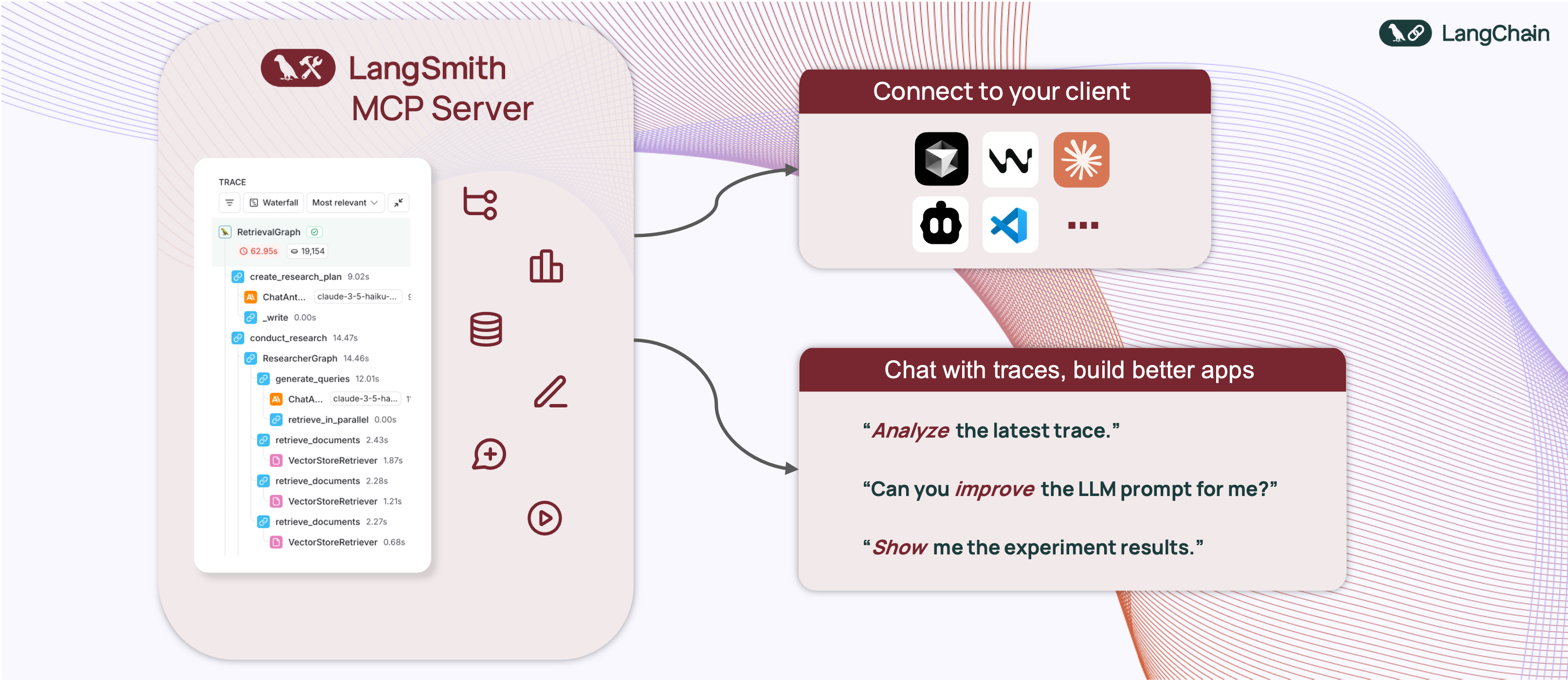


A production-ready Model Context Protocol (MCP) server that provides seamless integration with the LangSmith observability platform. This server enables language models to fetch conversation history, prompts, runs and traces, datasets, experiments, and billing usage from LangSmith.
📋 Example Use Cases
The server enables powerful capabilities including:
- 💬 Conversation History: "Fetch the history of my conversation from thread 'thread-123' in project 'my-chatbot'" (paginated by character budget)
- 📚 Prompt Management: "Get all public prompts in my workspace" / "Pull the template for the 'legal-case-summarizer' prompt"
- 🔍 Traces & Runs: "Fetch the latest 10 root runs from project 'alpha'" / "Get all runs for trace <uuid> (page 2 of 5)"
- 📊 Datasets: "List datasets of type chat" / "Read examples from dataset 'customer-support-qa'"
- 🧪 Experiments: "List experiments for dataset 'my-eval-set' with latency and cost metrics"
- 📈 Billing: "Get billing usage for September 2025"
🚀 Quickstart
A hosted version of the LangSmith MCP Server is available over HTTP-streamable transport, so you can connect without running the server yourself:
- URL:
https://langsmith-mcp-server.onrender.com/mcp - Hosting: Render, built from this public repo using the project's Dockerfile.
Use it like any HTTP-streamable MCP server: point your client at the URL and send your LangSmith API key in the LANGSMITH-API-KEY header. No local install or Docker required.
Example (Cursor mcp.json):
{
  "mcpServers": {
    "LangSmith MCP (Hosted)": {
      "url": "https://langsmith-mcp-server.onrender.com/mcp",
      "headers": {
        "LANGSMITH-API-KEY": "lsv2_pt_your_api_key_here"
      }
    }
  }
}
Optional headers: LANGSMITH-WORKSPACE-ID, LANGSMITH-ENDPOINT (same as in the Docker Deployment section below).
Note: This deployed instance is intended for LangSmith Cloud. If you use a self-hosted LangSmith instance, run the server yourself and point it at your endpoint—see the Docker Deployment section below.
🛠️ Available Tools
The LangSmith MCP Server provides the following tools for integration with LangSmith.
💬 Conversation & Threads
| Tool Name | Description |
|---|---|
get_thread_history | Retrieve message history for a conversation thread. Uses char-based pagination: pass page_number (1-based), and use returned total_pages to request more pages. Optional max_chars_per_page and preview_chars control page size and long-string truncation. |
📚 Prompt Management
| Tool Name | Description |
|---|---|
list_prompts | Fetch prompts from LangSmith with optional filtering by visibility (public/private) and limit. |
get_prompt_by_name | Get a specific prompt by its exact name, returning the prompt details and template. |
push_prompt | Documentation-only: how to create and push prompts to LangSmith. |
🔍 Traces & Runs
| Tool Name | Description |
|---|---|
fetch_runs | Fetch LangSmith runs (traces, tools, chains, etc.) from one or more projects. Supports filters (run_type, error, is_root), FQL (filter, trace_filter, tree_filter), and ordering. When trace_id is set, returns char-based paginated pages; otherwise returns one batch up to limit. Always pass limit and page_number. |
list_projects | List LangSmith projects with optional filtering by name, dataset, and detail level (simplified vs full). |
📊 Datasets & Examples
| Tool Name | Description |
|---|---|
list_datasets | Fetch datasets with filtering by ID, type, name, name substring, or metadata. |
list_examples | Fetch examples from a dataset by dataset ID/name or example IDs, with filter, metadata, splits, and optional as_of version. |
read_dataset | Read a single dataset by ID or name. |
read_example | Read a single example by ID, with optional as_of version. |
create_dataset | Documentation-only: how to create datasets in LangSmith. |
update_examples | Documentation-only: how to update dataset examples in LangSmith. |
🧪 Experiments & Evaluations
| Tool Name | Description |
|---|---|
list_experiments | List experiment projects (reference projects) for a dataset. Requires reference_dataset_id or reference_dataset_name. Returns key metrics (latency, cost, feedback stats). |
run_experiment | Documentation-only: how to run experiments and evaluations in LangSmith. |
📈 Usage & Billing
| Tool Name | Description |
|---|---|
get_billing_usage | Fetch organization billing usage (e.g. trace counts) for a date range. Optional workspace filter; returns metrics with workspace names inline. |
📄 Pagination (char-based)
Several tools use stateless, character-budget pagination so responses stay within a size limit and work well with LLM clients:
- Where it’s used:
get_thread_historyandfetch_runs(whentrace_idis set). - Parameters: You send
page_number(1-based) on every request. Optional:max_chars_per_page(default 25000, cap 30000) andpreview_chars(truncate long strings with "… (+N chars)"). - Response: Each response includes
page_number,total_pages, and the page payload (resultfor messages,runsfor runs). To get more, call again withpage_number = 2, then3, up tototal_pages. - Why it’s useful: Pages are built by JSON character count, not item count, so each page fits within a fixed size. No cursor or server-side state—just integer page numbers.
🛠️ Installation Options
📝 General Prerequisites
-
Install uv (a fast Python package installer and resolver):
curl -LsSf https://astral.sh/uv/install.sh | sh -
Clone this repository and navigate to the project directory:
git clone https://github.com/langchain-ai/langsmith-mcp-server.git
cd langsmith-mcp-server
🔌 MCP Client Integration
Once you have the LangSmith MCP Server, you can integrate it with various MCP-compatible clients. You have two installation options:
📦 From PyPI
-
Install the package:
uv run pip install --upgrade langsmith-mcp-server -
Add to your client MCP config:
{
    "mcpServers": {
        "LangSmith API MCP Server": {
            "command": "/path/to/uvx",
            "args": [
                "langsmith-mcp-server"
            ],
            "env": {
                "LANGSMITH_API_KEY": "your_langsmith_api_key",
                "LANGSMITH_WORKSPACE_ID": "your_workspace_id",
                "LANGSMITH_ENDPOINT": "https://api.smith.langchain.com"
            }
        }
    }
}
⚙️ From Source
Add the following configuration to your MCP client settings (run from the project root so the package is found):
{
    "mcpServers": {
        "LangSmith API MCP Server": {
            "command": "/path/to/uv",
            "args": [
                "--directory",
                "/path/to/langsmith-mcp-server",
                "run",
                "langsmith_mcp_server/server.py"
            ],
            "env": {
                "LANGSMITH_API_KEY": "your_langsmith_api_key",
                "LANGSMITH_WORKSPACE_ID": "your_workspace_id",
                "LANGSMITH_ENDPOINT": "https://api.smith.langchain.com"
            }
        }
    }
}
Replace the following placeholders:
/path/to/uv: The absolute path to your uv installation (e.g.,/Users/username/.local/bin/uv). You can find it withwhich uv./path/to/langsmith-mcp-server: The absolute path to the project root (the directory containingpyproject.tomlandlangsmith_mcp_server/).your_langsmith_api_key: Your LangSmith API key (required).your_workspace_id: Your LangSmith workspace ID (optional, for API keys scoped to multiple workspaces).https://api.smith.langchain.com: The LangSmith API endpoint (optional, defaults to the standard endpoint).
Example configuration (PyPI/uvx):
{
    "mcpServers": {
        "LangSmith API MCP Server": {
            "command": "/path/to/uvx",
            "args": ["langsmith-mcp-server"],
            "env": {
                "LANGSMITH_API_KEY": "lsv2_pt_your_key_here",
                "LANGSMITH_WORKSPACE_ID": "your_workspace_id",
                "LANGSMITH_ENDPOINT": "https://api.smith.langchain.com"
            }
        }
    }
}
Copy this configuration into Cursor → MCP Settings (replace /path/to/uvx with the output of which uvx).

🔧 Headers (tool invocation)
When connecting over HTTP (e.g. streamable HTTP or a hosted MCP endpoint), the server uses headers for authentication and configuration. Your MCP client must send these with each request; no environment variables are required for tool invocation.
| Header | Required | Description |
|---|---|---|
LANGSMITH-API-KEY | ✅ Yes | Your LangSmith API key for tool calls (list prompts, fetch runs, etc.) |
LANGSMITH-WORKSPACE-ID | ❌ No | Workspace ID for API keys scoped to multiple workspaces |
LANGSMITH-ENDPOINT | ❌ No | Custom API endpoint URL (for self-hosted or EU region) |
Optional headers used only when server monitoring is enabled (for grouping traces by session):
| Header | Description |
|---|---|
mcp-session-id | Session or thread id; stored in trace metadata as session_id |
x-session-id | Fallback if mcp-session-id is not set |
x-request-id | Fallback for request-scoped grouping |
Stdio transport: When running the server over stdio (e.g. uvx langsmith-mcp-server), there are no headers. The server falls back to the environment variables LANGSMITH_API_KEY, LANGSMITH_WORKSPACE_ID, and LANGSMITH_ENDPOINT in the process environment so that tool invocation still works.
🔧 Environment variables
Environment variables are not used for tool invocation when using HTTP (headers are). They are used for:
- Stdio transport – fallback for credentials when no headers exist (see above).
- Load tests – e.g.
tests/load_test_sessions.pyreadsLANGSMITH_API_KEYfrom the environment (or a.envfile at the project root). - Optional server monitoring – tracing tool calls to a second LangSmith instance (see below).
| Variable | Used for | Description |
|---|---|---|
LANGSMITH_API_KEY | Stdio fallback, load tests | LangSmith API key (when not provided via headers) |
LANGSMITH_WORKSPACE_ID | Stdio fallback | Workspace ID (optional) |
LANGSMITH_ENDPOINT | Stdio fallback | Custom endpoint URL (optional) |
Optional: Tool-call monitoring to a second LangSmith instance
You can log every MCP tool call (with inputs and outputs) to a separate LangSmith project for monitoring and analytics. Set these in your environment (e.g. in a .env file at the project root; the server loads .env via python-dotenv):
| Variable | Required | Description |
|---|---|---|
LANGSMITH_MONITORING_API_KEY | Yes (to enable) | API key for the LangSmith instance used for monitoring |
LANGSMITH_MONITORING_ENDPOINT | No | Endpoint URL (default: cloud) |
LANGSMITH_MONITORING_WORKSPACE_ID | No | Workspace ID for the monitoring instance |
LANGSMITH_MONITORING_PROJECT | No | Project name for monitoring traces (default: mcp-server-monitoring) |
LANGSMITH_TRACING | Yes (to send traces) | Set to true so traces are sent to LangSmith (custom instrumentation) |
Each tool run is traced with run_type="tool" and a session_id in metadata (from the mcp-session-id, x-session-id, or x-request-id header when using HTTP, or generated per request).
If you use the hosted LangSmith MCP Server, anonymous usage data is sent to a separate LangSmith project so we can iterate and improve the product.
🐳 Docker Deployment (HTTP-Streamable)
The LangSmith MCP Server can be deployed as an HTTP server using Docker, enabling remote access via the HTTP-streamable protocol.
Building the Docker Image
docker build -t langsmith-mcp-server .
Running with Docker
docker run -p 8000:8000 langsmith-mcp-server
The API key is provided via the LANGSMITH-API-KEY header when connecting, so no environment variables are required for HTTP-streamable protocol.
Connecting with HTTP-Streamable Protocol
Once the Docker container is running, you can connect to it using the HTTP-streamable transport. The server accepts authentication via headers:
Required header:
LANGSMITH-API-KEY: Your LangSmith API key
Optional headers:
LANGSMITH-WORKSPACE-ID: Workspace ID for API keys scoped to multiple workspacesLANGSMITH-ENDPOINT: Custom endpoint URL (for self-hosted or EU region)
Example client configuration:
from mcp import ClientSession
from mcp.client.streamable_http import streamablehttp_client

headers = {
    "LANGSMITH-API-KEY": "lsv2_pt_your_api_key_here",
    # Optional:
    # "LANGSMITH-WORKSPACE-ID": "your_workspace_id",
    # "LANGSMITH-ENDPOINT": "https://api.smith.langchain.com",
}

async with streamablehttp_client("http://localhost:8000/mcp", headers=headers) as (read, write, _):
    async with ClientSession(read, write) as session:
        await session.initialize()
        # Use the session to call tools, list prompts, etc.
Cursor Integration
To add the LangSmith MCP Server to Cursor using HTTP-streamable protocol, add the following to your mcp.json configuration file:
{
  "mcpServers": {
    "HTTP-Streamable LangSmith MCP Server": {
      "url": "http://localhost:8000/mcp",
      "headers": {
        "LANGSMITH-API-KEY": "lsv2_pt_your_api_key_here"
      }
    }
  }
}
Optional headers:
{
  "mcpServers": {
    "HTTP-Streamable LangSmith MCP Server": {
      "url": "http://localhost:8000/mcp",
      "headers": {
        "LANGSMITH-API-KEY": "lsv2_pt_your_api_key_here",
        "LANGSMITH-WORKSPACE-ID": "your_workspace_id",
        "LANGSMITH-ENDPOINT": "https://api.smith.langchain.com"
      }
    }
  }
}
Make sure the server is running before connecting Cursor to it.
Health Check
The server provides a health check endpoint:
curl http://localhost:8000/health
This endpoint does not require authentication and returns "LangSmith MCP server is running" when the server is healthy.
🧪 Development and Contributing
Prerequisites
- Python 3.10+ (3.11+ recommended)
- uv – install with
curl -LsSf https://astral.sh/uv/install.sh | sh - LangSmith API key – from smith.langchain.com
- Node.js (optional) – only if you want to use MCP Inspector to test the server (stdio or streamable-http)
Setup
git clone https://github.com/langchain-ai/langsmith-mcp-server.git
cd langsmith-mcp-server

uv sync                    # Install dependencies
uv sync --group test       # Include test dependencies (pytest, ruff, mypy)

uvx langsmith-mcp-server   # Verify CLI runs (stdio)
Development workflow
- Edit code in
langsmith_mcp_server/ortests/. - Format and lint (required before committing):
make format make lint - Run tests:
make test # Or a single file: make test TEST_FILE=tests/tools/test_dataset_tools.py - Type-check (optional):
uv run mypy langsmith_mcp_server/
Testing with MCP Inspector
You can test the server with MCP Inspector using either stdio or streamable-http.
-
Start MCP Inspector:
npx @modelcontextprotocol/inspector@latestOpen http://localhost:6274 in your browser.
-
Connect in the Inspector:
- Stdio: Choose stdio transport and configure the server command (e.g.
uv run langsmith-mcp-server) and setLANGSMITH_API_KEYin the environment. - Streamable HTTP: Start the server first (
uv run uvicorn langsmith_mcp_server.server:app --host 0.0.0.0 --port 8000or Docker), then choose streamable-http, URLhttp://localhost:8000/mcp, and add headerLANGSMITH-API-KEY= your API key.
- Stdio: Choose stdio transport and configure the server command (e.g.
Load testing
A session-based load test opens many MCP sessions and calls the list_prompts tool in each, using langchain-mcp-adapters. Run from the CLI (no UI). The server must be running first.
uv sync --group load
# Terminal 1: start the server
uv run uvicorn langsmith_mcp_server.server:app --host 0.0.0.0 --port 8000
# Terminal 2: run the load test
uv run python tests/load_test_sessions.py --sessions 20 --calls-per-session 3
Options
| Option | Default | Description |
|---|---|---|
--url | http://localhost:8000/mcp | MCP endpoint URL |
--api-key | from .env | LANGSMITH_API_KEY (or set in project root .env) |
--sessions | 10 | Number of concurrent sessions |
--calls-per-session | 3 | list_prompts calls per session |
--debug | off | Print step-by-step logs and first error traceback |
--report PATH | — | Write a report after the run (see below) |
Report
Use --report PATH to write a JSON report after the test (e.g. --report load_test_report creates load_test_report.json with config, summary, per-session results, and first error).
uv run python tests/load_test_sessions.py --sessions 5 --report load_test_report
# Creates: load_test_report.json (in current directory)
Contributing checklist
Before opening a PR:
-
make formatandmake lintpass -
make testpasses - New tools or behavior are documented (e.g. in CLAUDE.md if you change architecture or tools)
- Error handling in tools returns
{"error": "..."}rather than raising
For more detail (adding tools, code standards, troubleshooting), see CLAUDE.md.
📄 License
This project is distributed under the MIT License. For detailed terms and conditions, please refer to the LICENSE file.
Made with ❤️ by the LangChain Team